Unit 6.2 Taxonomic Categories
Biology → Biology → CLASSIFICATION → CLASSIFICATION → Classification & Taxonomy | Author: admin | Feb 24, 2026
Taxonomic Categories Taxonomic categories, also called taxonomic ranks or hierarchical levels, form the framework of biological classification. Organisms are arranged in a series of successive groups from broadest (most inclusive, shared by many organisms) to narrowest (most specific, unique to few or one organism). This hierarchy, proposed by Linnaeus and refined over time, reflects degrees of similarity and evolutionary relationships. Each level is called a taxon (plural: taxa), and the process is taxonomic hierarchy.
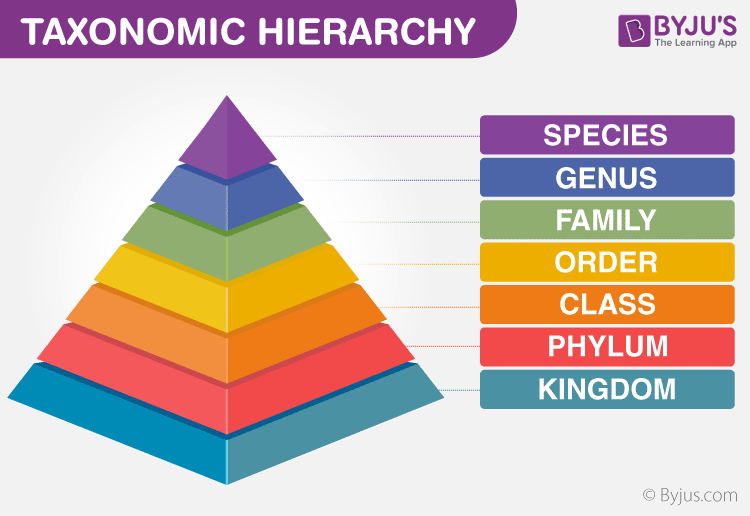
Main Taxonomic Categories (Hierarchy) The standard hierarchical levels (from broadest to most specific) are:
- Kingdom — Highest level; groups organisms with broad similarities (e.g., Animalia for animals, Plantae for plants).
- Phylum (animals) or Division (plants) — Groups based on major body plans or structural features (e.g., Chordata for animals with notochord/backbone).
- Class — Subdivides phylum/division by more specific traits (e.g., Mammalia for warm-blooded, milk-producing vertebrates).
- Order — Groups families with common characteristics (e.g., Carnivora for meat-eating mammals).
- Family — Closer relatives sharing traits (e.g., Felidae for cat-like carnivores).
- Genus — Closely related species; usually includes organisms that can interbreed or share recent ancestry (e.g., Panthera for big cats).
- Species — Basic/fundamental unit; group of organisms that can interbreed naturally to produce fertile offspring and share most characteristics (e.g., tigris for tiger).

![BIOLOGY] Levels of Classification: Phylum, Class, Order, Family, Genus, Species — Filipino Science Hub](https://images.squarespace-cdn.com/content/v1/5f02d28f35d64d2a5022eeb1/1616645642125-X25A9KW1W62NVAH4DOJR/29.png)
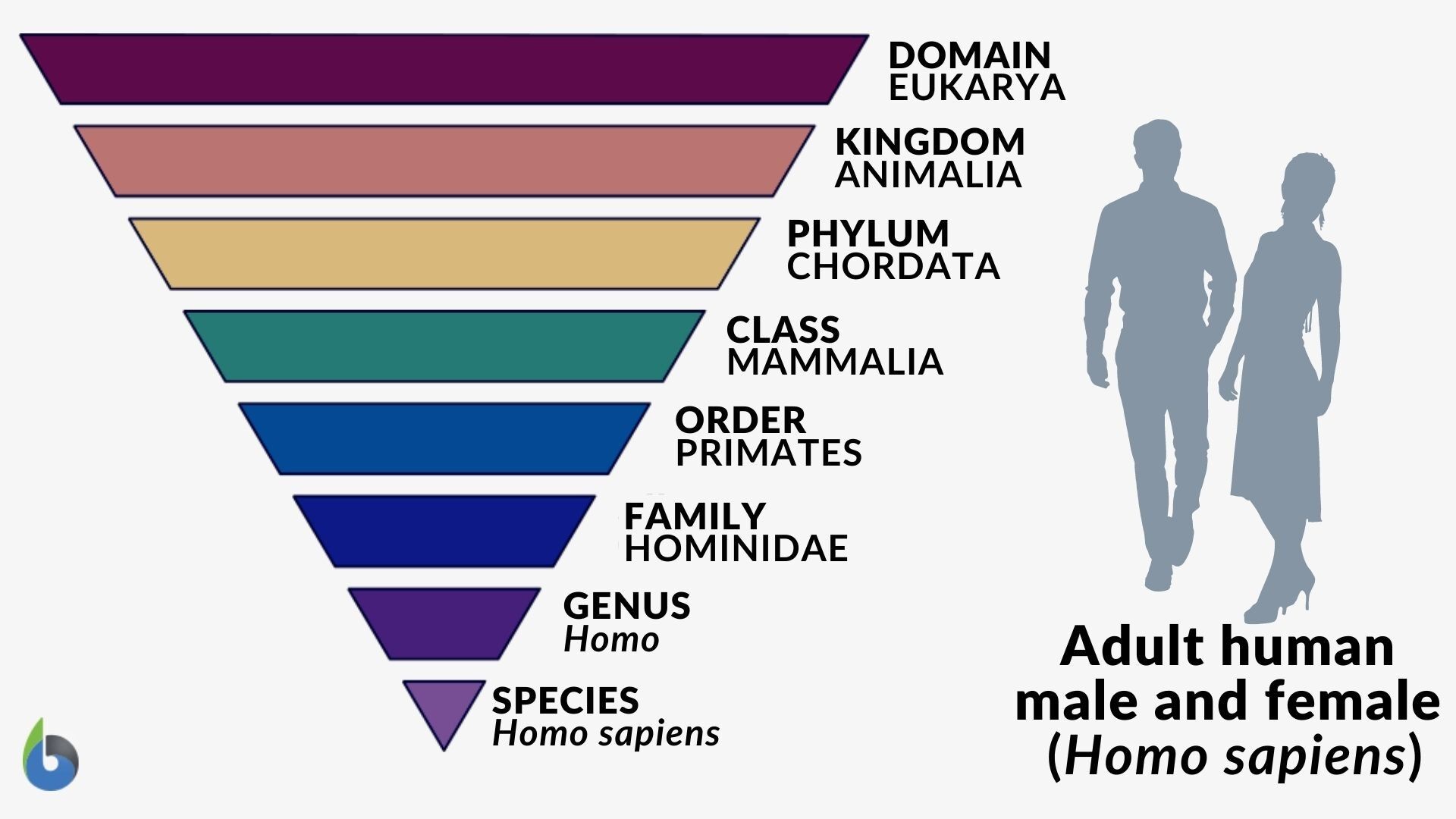
Higher categories (Kingdom to Class) show broader similarities and more organisms; lower ones (Order to Species) indicate closer relationships and fewer organisms. As we move down the hierarchy, number of shared characters increases, while diversity decreases.
Binomial Nomenclature Developed by Carolus Linnaeus, each organism gets a scientific name with two parts: Genus (capitalized) + species (lowercase), italicized or underlined. Example: Homo sapiens (human), Mangifera indica (mango), Panthera leo (lion). This provides universal, precise naming.

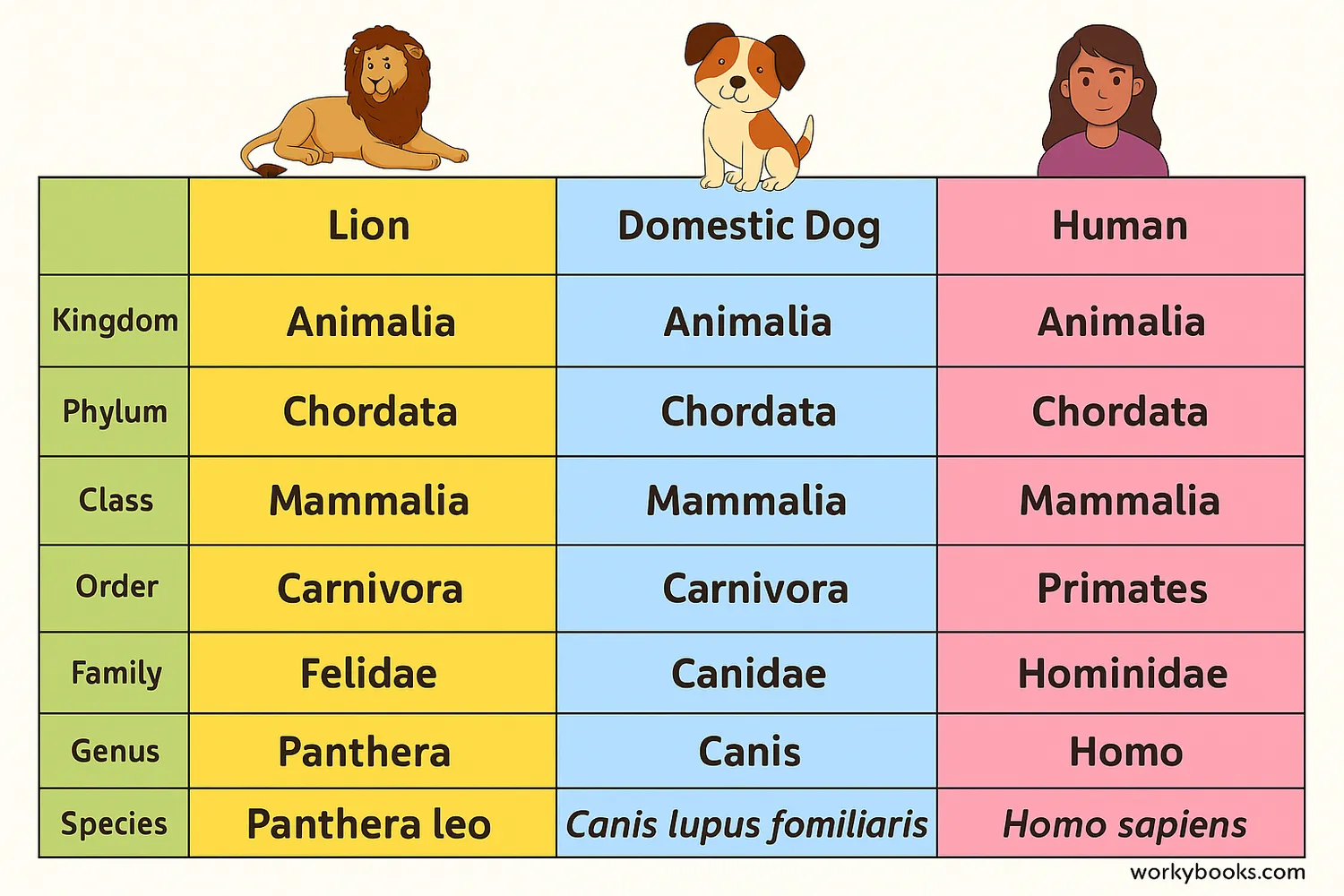
Examples of Hierarchy
- Human (Homo sapiens): Kingdom Animalia → Phylum Chordata → Class Mammalia → Order Primates → Family Hominidae → Genus Homo → Species sapiens.
- Mango (Mangifera indica): Kingdom Plantae → Division Angiospermae → Class Dicotyledonae → Order Sapindales → Family Anacardiaceae → Genus Mangifera → Species indica.

Section 2: Quick Revision, Exam Tips, and Traps
Quick Revision Points
- Hierarchy: Kingdom (broadest) → Phylum/Division → Class → Order → Family → Genus → Species (most specific).
- Taxon: Any category/level in hierarchy (e.g., Mammalia is a taxon at class level).
- Species: Smallest, reproductively isolated group; basic unit of classification.
- Binomial name: Genus species (e.g., Felis domesticus for house cat; note: domesticus often felis catus in modern usage).
- Broader taxa: More inclusive, fewer shared characters; narrower taxa: More specific, more shared characters.
Exam Tips
- Always draw the hierarchy as an inverted pyramid or ladder (broad at top, specific at bottom) with labels; use examples like lion, human, or mango.
- Memorize order with mnemonic: "King Philip Came Over For Good Soup" (Kingdom, Phylum, Class, Order, Family, Genus, Species).
- For competitive exams (UPSC/SSC/RRB/TGPSC): Specify phylum for animals, division for plants; mention species as basic unit and reproductive isolation.
- Tabulate hierarchy for 2–3 organisms (e.g., lion, tiger, human) to show similarities/differences.
- Link to binomial nomenclature: Genus capitalized, species lowercase, italicized; no common names in scientific context.
Common Traps to Avoid
- Trap: Calling species the broadest level → Wrong; it's the most specific/narrowest.
- Trap: Saying taxon only means species → Wrong; taxon is any hierarchical level (kingdom is also a taxon).
- Trap: Writing binomial name incorrectly (e.g., panthera leo lowercase genus or not italicized).
- Trap: Confusing phylum and division → Phylum for animals, division for plants (NCERT emphasis).
- Trap: Stating hierarchy is fixed → It can include extra ranks (subphylum, superfamily) or domain above kingdom in modern systems, but NCERT Class 11 sticks to basic seven.
Section 3: Previous Asked Questions-Answers and Expected Questions-Answers
Previous/Frequently Asked Questions (NCERT-based, Competitive Style)
- What is taxonomic hierarchy? Answer: Arrangement of organisms in successive groups (taxa) from kingdom to species in decreasing order of similarity; broader levels more inclusive, narrower more specific.
- Name the seven obligate categories of classification. Answer: Kingdom, Phylum (or Division), Class, Order, Family, Genus, Species.
- What is a taxon? Give an example. Answer: Any rank/level in taxonomic hierarchy; example: Mammalia (class), Felidae (family), or Homo sapiens (species).
- Why is species considered the basic unit of classification? Answer: It is the smallest group where organisms can interbreed naturally to produce fertile offspring; shows maximum similarity and reproductive isolation.
Expected Questions (High Probability for 2026 Exams)
- Explain taxonomic categories with a suitable example (e.g., human or lion) in hierarchical order (5 marks). Expected: List levels from kingdom to species with characteristics; draw pyramid diagram.
- Differentiate between genus and species (tabular, 3 marks). Expected: Genus — group of related species, capitalized; Species — specific, lowercase, reproductive unit.
- What is binomial nomenclature? Write the scientific name of tiger and explain its parts. Expected: Two-word name (Genus species); Panthera tigris — Panthera (genus, big cats), tigris (species).
- As we go from species to kingdom, how do shared characters and number of organisms change? Expected: Shared characters decrease, number of organisms increases (broader taxa more diverse).
- Why are common names inadequate? How does taxonomic hierarchy help? Expected: Common names vary regionally/language; hierarchy + binomial provides universal, precise identification and shows relationships.